How to Manage Travel Leads Without Excel
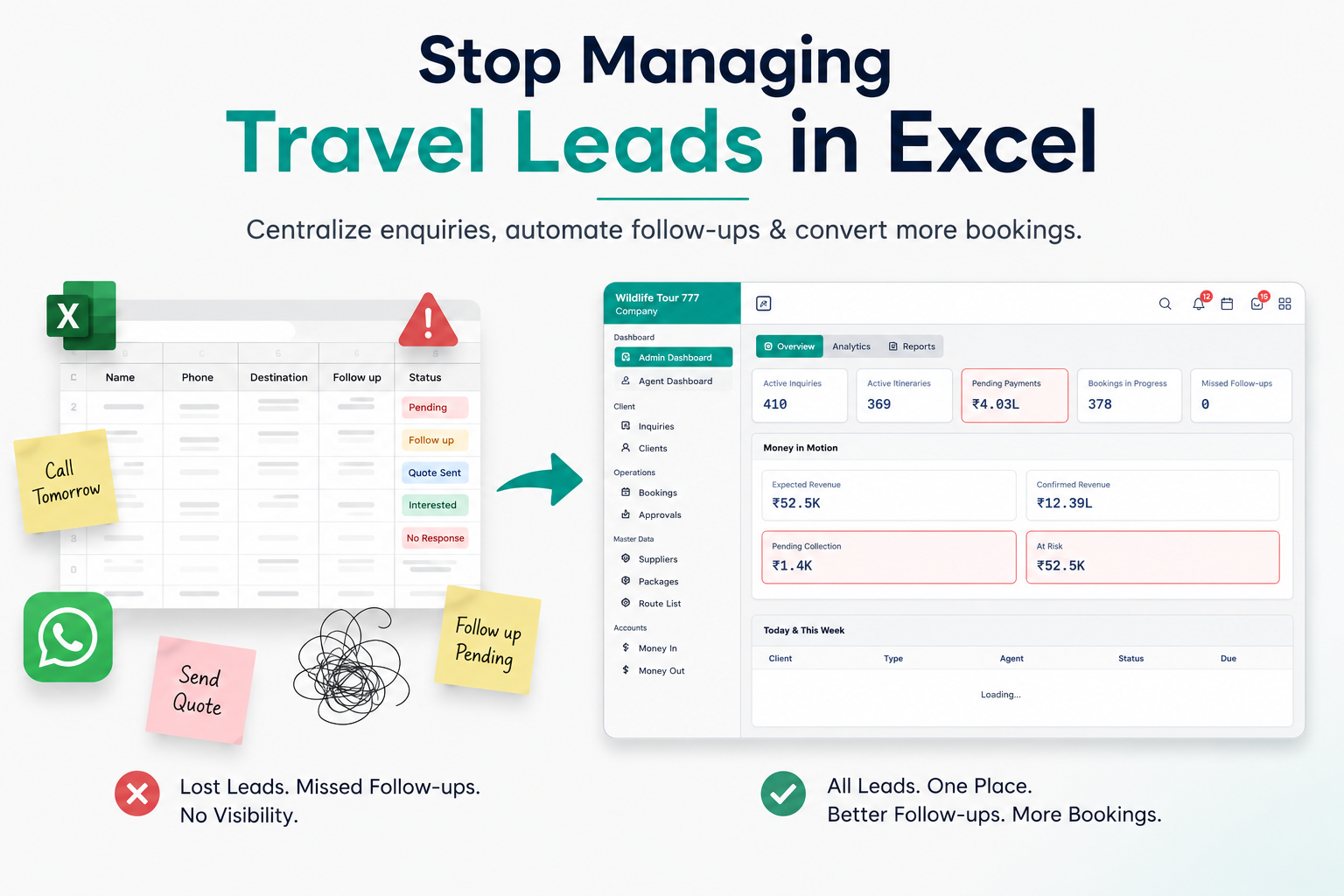
When you are struggling with spreadsheets, random chats, and mental notes, you probably understand how complicated the process of lead management can be. Spreadsheets serve as a starting point for many travel companies because they are easy, well-known, and available for free. However, when the number of enquiries increases, complications appear. Thus, the question arises of how to manage travel leads without Excel while maintaining positive conversion rates.
Nowadays, it is obvious that travel agencies should have a system which would not only collect data but also help to seal deals. From the very first contact till the final booking, every conversation is important.
The "Excel + WhatsApp" Trap Most Agencies Fall Into
It typically begins easily. People reach out to you via WhatsApp, Instagram, website forms, or phone calls. You log it in Excel. You may even color the rows or insert comments. It seems easy at first, but with time, things start becoming unmanageable.
Here's what your day will look like shortly after that:
- Scanning through chats to spot a lead.
- Not remembering whom you sent a quote to yesterday.
- Duplicating information in different sheets.
- Failing to get back to someone because there’s no follow-up process.
The combination of spreadsheets and communication apps leads to a disjointed workflow. Although it might appear to be travel lead management, it is just fragmented tracking. You are responding rather than managing.
What’s the biggest problem? The lack of one source of truth! When information exists in various locations, things get missed, often costing you bookings.
5 Reasons Excel Is Killing Your Conversion Rate
1. Lost Conversations = Lost Opportunities
Conversations aren’t stored in Excel. The important preference of a client you heard about on WhatsApp? It will be lost unless you record that manually. Lack of context results in ineffective follow-ups.
2. No Automated Reminders
Memory is your only helper. You have to manually keep track of all the details when there’s no travel enquiry management system, and a promising lead is lost just because you didn’t think of following up.
3. Zero Visibility on Progress
There’s no way to see the status of a lead in real-time mode. Without a proper sales pipeline, you won’t be able to focus on high-potential customers.
4. Time Wasted on Manual Updates
Every input is done manually. That cuts down on your time for sales or providing a better customer experience.
5. No Collaboration Across Teams
If there are several employees in charge of a certain process, Excel becomes a bottleneck. Information is duplicated, overlapped, or worse: ignored.
Right here, Excel stops being an efficient instrument and becomes a limitation.
Real-Life Example of a Lost Lead Due to Messy Spreadsheets
Suppose a potential client approaches you for a honeymoon package for Bali. He is clear on his date, budget, and requirements. You mark it in Excel and tell him that you will revert.
After that, another query comes in. Yet another after that. The end result is that you do update your Excel file, but the WhatsApp chat related to the Bali query gets buried somewhere in there.
Two days later, you realize that you should have sent a quote to this guy already, so you send it. But guess what?
The potential client does not respond.
Guess why?
Because he was already booked by some other agency, which responded to him within hours of his approach.
The Step-by-Step CRM Workflow to Replace Excel
Switching does not necessarily complicate things; it simplifies them. Here is the process of the new-age workflow:
- Step 1: Capture Every Lead Automatically: All enquiries from all channels automatically land in one single place without any need for manual entry.
- Step 2: Centralize Communication: All communications and updates on calls stay associated with the enquiry. There is no switching back and forth between applications.
- Step 3: Assign and Track Leads: Assign the leads and follow up on them with your team members. So, everyone is aware of who’s handling what.
- Step 4: Set Follow-Up Reminders: You will never forget any leads. Automatic reminders help you keep track of communication.
- Step 5: Visualize Your Pipeline: Follow the progress of each lead, from enquiry to booking, by creating a proper flow.
- Step 6: Analyze and Improve: Understand what works and what doesn’t. Better analytics will help you make better decisions.
This is when a proper travel CRM system becomes crucial. Not as an extra piece of software, but the foundation of your work.
How Track Itinerary Centralizes Leads
That's exactly where the Track Itinerary comes in handy. No need to use different tools – all the data will be in one place.
- Get leads from various sources in one dashboard
- Have a conversation history for each of your clients
- Send automated reminders and follow-ups effortlessly
- Control the progress in the lead management pipeline
- Facilitate teamwork without complications
Its strength lies in its simplicity. No technical knowledge needed and no complicated setup process. This tool was made with the specifics of the travel industry in mind.
If you're looking for a more efficient Excel alternative, here's where the change begins.
Conclusion
Travel leads management is not only about data management; it is about acting quicker, gaining better insights, and converting more efficiently. While Excel will help initially, it cannot grow with your business.
It all starts happening once you move from data collection to lead management itself. The moment you capture all the leads, follow up in time, and capitalize on each opportunity. That’s when you stop losing leads and start closing them.
The change doesn’t necessarily have to be difficult. Begin with baby steps, improve your system, and watch your process grow with your company.
Because in this world of stiff competition, sometimes it’s not even about winning or losing the client, but rather how well you manage the lead.